- The Counterpublic Papers
- Posts
- The Counterpublic Papers vol. 10 no. 11
The Counterpublic Papers vol. 10 no. 11

Lester Spence
May 07, 2026
This Week
On the End of the Voting Rights Act
What we do in response (PT 1)
Cohado Kickstarter
The End of the Voting Rights Act
On Wednesday, April 29, 2026 in Louisiana v. Callais, the United States Supreme Court decided 6-3 to reduce the use of race in creating congressional districts to efforts designed to remedy contemporary intentional discrimination. Although the Voting Rights Act itself was passed and then reauthorized several times by bipartisan majorities, including most recently in 2006, conservatives have long sought to hamstring it— Since the reactionary 6-3 majority was constructed, the SC has worked to reduce the scope and scale of the legislation one case at a time, finalizing a project John Roberts was involved in as early as 1982 as a lawyer working in the Reagan administration. Practices designed to reduce black voting capacity are rarely if ever “intentional,” and rarely if ever solely contemporary. The Voting Rights Act is now “a dead letter.” Southern states will now move swiftly to redistrict, leading to a likely decline in black representatives, and any attempt to remedy that will now be viewed in the wake of Callais as an illegal form of racial discrimination.
Political scientist (and fraternity brother) D’Ande Orey created this helpful figure.
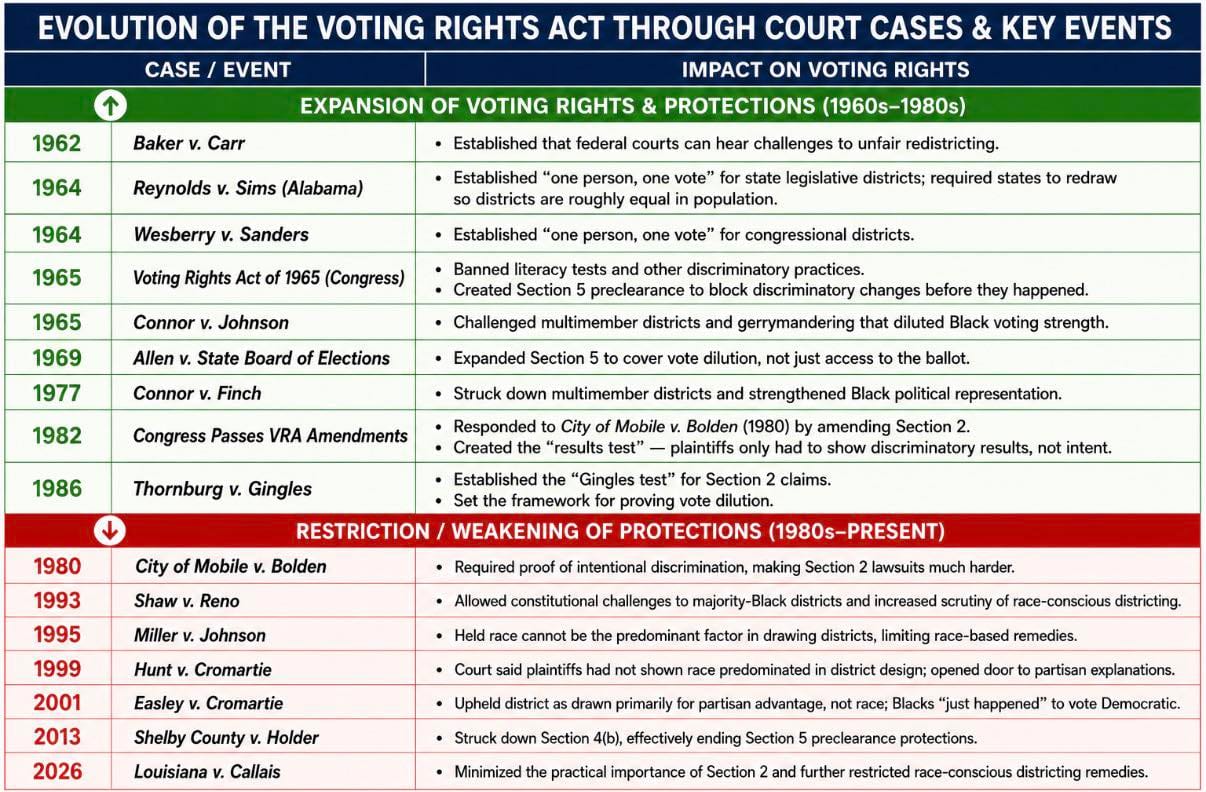
Further, two excellent articles get at this. (Let me know if you can’t get them and I’ll shoot you the pdf.)
My short take? We’ve been in a long term struggle over the meaning of the Constitution. Conservative/reactionaries view the document as one designed to protect capital and the specific ethno-racial group most associated with the Constitution’s creation, and as such view the 13th , 14th , and 15th amendments as ones that must be neutered if the nation is to survive, rather than ones central to the existence of a multi-racial democracy. They’ve wanted to remove the 13th , 14th , and 15th amendment or at the very least neuter them. As a result of Trump’s second election, they achieved the means to
In the wake of the decision, I want to quickly jot down thoughts about where we are and where we go from here.
My colleague and friend Daryl Scott argues that what we’re looking at is not disfranchisement but rather disempowerment. Scott is a historian, not a political scientist, so when he’s thinking about the distinction between the two he’s thinking as a historian. He views disfranchisement as a specific technique devised in the late 19th and early 20th century to actively reduce black civic capacity by actively reducing the ability of individual black citizens to cast votes.
This, he argues, is not that. What we’re looking at instead is disempowerment. Black people will still be able to cast votes, but the effect of those votes will be limited. Particularly after the redistricting enabled through weakening and now gutting the VRA, black people will no longer have the same capacity to elect representatives of their choice, but they will have the right to vote.
I’m of two minds.
In a general sense I agree with Scott. Scott has been suspicious of most attempts to apply early to mid-twentieth century concepts to the modern moment. I think I wrote about this in Knocking the Hustle, in reference to the “new Jim Crow” concept associated with Michelle Alexander’s book. It isn’t just that these concepts are wrong in that they don’t accurately describe contemporary phenomena. It isn’t even that these concepts are lazy. It’s that these concepts do damage to our very attempt to understand the phenomenon they’re used to describe. And in moments like this, the damage these concepts do also damages our ability to respond. So yes, we aren’t looking at disfranchisement, something associated with the Jim Crow regime. We are likely looking at disempowerment.
But note the likely.
I’d suggest that we don’t actually know what this policy will mean on the ground, in part because one of the things we need to have in order to have knowledge about what is happening on the ground is an appropriate data collecting infrastructure. The Voting Rights Act was the entity that generated that appropriate data collecting infrastructure. It is very well possible we are looking at something like disfranchisement. Enough that the language may very well apply. Many of the protections designed to protect the vote in general were protections that came from and through the Voting Rights Act. Democratization in the United States had a lot of moving parts…most of those parts revolved around black folk. So as I type this I think even though he may be right, he isn’t quite going far enough in thinking through its effects. Gutting the Voting Rights Act doesn’t just disempower (at best) black people…it disempowers democracy itself. The wave of corruption so pervasive that it has become almost mind-numbing? It’s the cause and the effect the Supreme Court decision.
Where we go from here PT 1
With this said, what do we do?
Ideationally legal scholars have already developed a new theory of constitutionalism, one that articulates the type of relationship between the federal branches of government that should structure our efforts. I posted this before but I’ll do so again, and I’ll do it alongside this video by Jamelle Bouie.
The constitutional theory that currently dominates our politics is one that emphasizes concentration in the least democratic branches of government (the presidency, the Supreme Court, and the Senate rather than the House of Representatives) and then relatedly concentrated corporate power as ones best primed to support ethno-racial rule. The new constitutional theory—which isn’t really new inasmuch as it has its roots in Reconstruction—urges instead concentrating power in the most democratic branch of government, Congress, with the overall goal of reducing both corporate power (and relatedly, billionaire power) and ethno-racial rule.
(Why do we need a new theory? Isn’t it enough to simply get the current Republican Party out of power? The short answer is, no. It isn’t enough. It may be necessary, but it is insufficient. We’re going to have to get them out of office and then remake the government to make it extremely difficult for them to exert governing authority. This requires generating a new set of institutions, and a new common sense. For this, we need a new theory.)
We need to put political pressure on individual elected officials, on individuals running for office, and on individual office holders to fight for and support this new theory of government.
We do this not only for individual office holders (conceivably at every level), we do so for anyone who’s ever held office (Obama I see you) as well as anyone even thinking about running. Further, we do this for anyone putting pen to paper (or its social media equivalent).
(I’m focusing on elections and electoral politics not because I think that’s the be all end all, I don’t, but because I don’t see how we get anywhere close to where we want to go without some sort of electoral force. But for folk who don’t believe in elections, people have been calling for a General Strike sense Trump’s election. I don’t see something like that in the cards necessarily, we haven’t evinced the capacity to do this….but that doesn’t mean that we can’t build capacity. For folks not particularly invested in electoral politics, organizing populations to do something like a mass strike would be important. At the very least the electoral and non-electoral branches can work as something like a pincer. Making elections more likely, and then after elections—because one of the central problems after the elections even if we win will be the reluctance of center-liberal democrats to make the hard changes necessary—putting pressure on newly elected officials to do the work we need them to do.)
I haven’t focused on what this means expressly for black politics. In the next issue, I’ll do so.
Cohado Kickstarter
I’ve known Paulo Gregory for the better part of 15 years. He’s been working on a game that functions as “a game game” but also as a way to bridge divides. The game is Cohado and while I don’t believe a game can change our political terrain, I do believe that we have to use as many tools and techniques as possible to both generate the change we want to see in the world and make that change durable. I’ve played it, and I’m supporting it through kickstarter. If you’re part of an organization that works to build power by bringing folk with different interests and ideas together, I think something like Cohado can help overcome certain types of hard to wrestle with differences.
The semester is over. All that is left is the grading. In a few weeks we’ll be hosting the fourth annual Racial Politics Summer Institute. And the day after that, June 6, it looks like we’ll be hosting the tenth anniversary of the party we held to celebrate Prince’s life. And in between I’ll be in London. Talk soon. |